Access Sensitive Files and Customer Data
Quietly reading and copying business files or protected customer records, often without leaving an obvious trace.
Imagine opening an invoice email from a vendor you work with every week, only to find the familiar address has been hijacked to harvest your credentials. In that moment, your entire operation could hang in the balance.
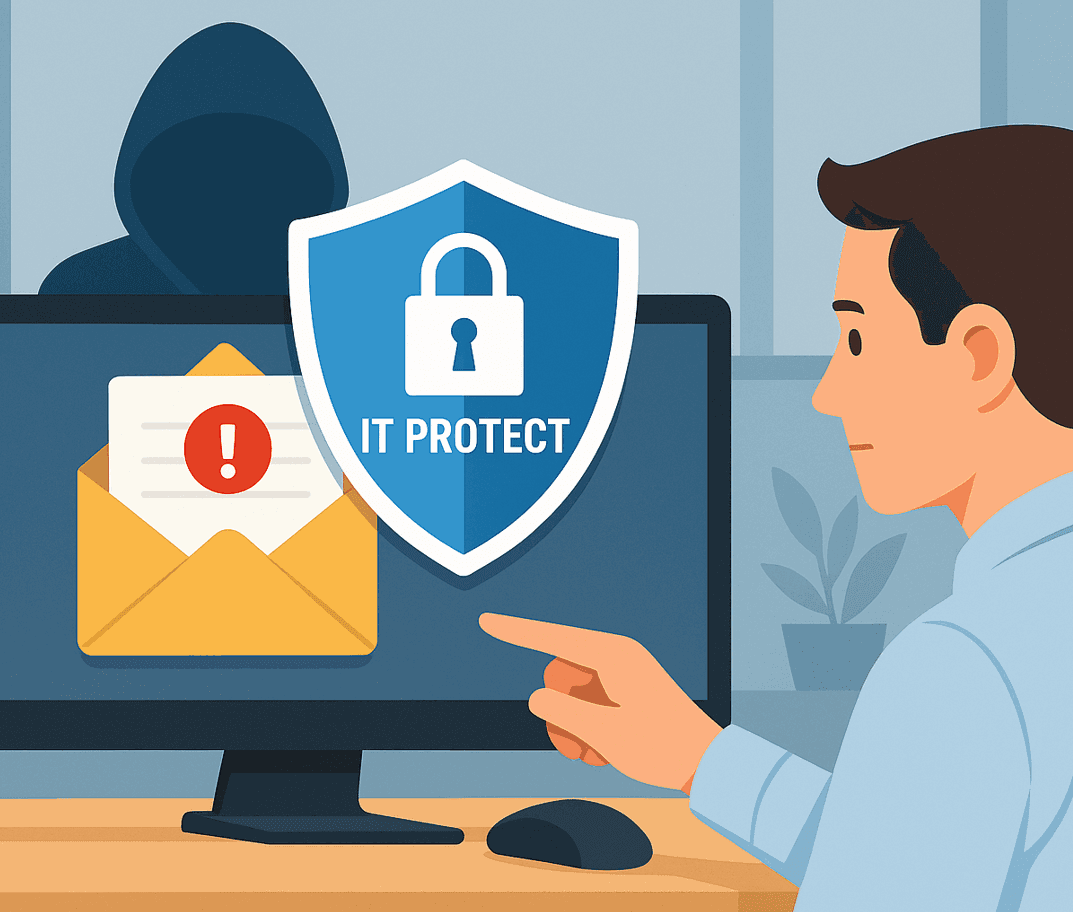
It is not a Hollywood script. It is an all-too-common scenario businesses face every day. That is exactly what one of our clients dealt with recently, and if it had not been for the layered protections built into the IT PROTECT platform, they could have had a very bad day.
Every day, cybercriminals exploit the channels you trust most, turning routine communications into gateways for disaster. Over 80% of data breaches involve compromised credentials, and 92% of malware is delivered by email. For small and mid-sized businesses, those are not just statistics, they are red flags flashing daily in your employees' inboxes.
Our client received an email from a vendor they interact with frequently. Same sender, same format, same kind of attachment. Nothing about it stood out. They followed the normal process and opened the password-protected document. What they didn't realize was that the vendor's email account had been compromised, and the attackers were using it exactly as the legitimate user would, redirecting the recipient to a malicious site that looked precisely like what they expected. A single click was all it took to hand the attackers our client's credentials.
Shortly after, the IT PROTECT platform flagged a login from a location that didn't fit the employee's typical behavior, thousands of miles from where they actually were. Our monitoring detected the anomaly and notified the security engineers in our Security Operations Center, who immediately locked the account before it could explore, monitor, or exfiltrate any data.
What's scary is that the client even had Multi-Factor Authentication configured. MFA isn't foolproof, which is precisely why you layer your defenses. The attackers used the harvested credentials to log in legitimately, which prompted the system to send the MFA request to our client exactly as it normally would. Once that was approved, the attackers had what they needed, while our client was quietly sent into a login loop.
Our platform caught the unusual login and the SOC team acted immediately. The user's account was disabled and all active sessions were signed out to stop the threat actors from any further reconnaissance. We contacted the employee to confirm they were not traveling, verified with our engineers that the remote IP was known to be malicious, then reset and issued temporary credentials and enforced a full session purge so no lingering connections remained.
Though not headline-grabbing, this incident underscores the importance of continuous monitoring. Our clients weren't lucky, they were simply smart enough to invest in a proper technology strategy. There was no alarm sounding in the background, just our platform doing what it was designed to do: catch problems early and respond before they spread. A major cyber incident can cost roughly 100 times more than investing in the right protection in the first place.
Things escalate quickly when a business lacks the right strategy and protections to prevent, mitigate, and recover from incidents. Without a managed platform like IT PROTECT watching in real time, the attacker could have used that single login to do real and lasting damage.
Without protection in place, here is what that one login could have become.
Quietly reading and copying business files or protected customer records, often without leaving an obvious trace.
Sending convincing phishing emails from the compromised account to others inside and outside the company, widening the breach.
Pushing malicious payloads across synced systems and devices, potentially halting the whole operation.
Tampering with inbox rules or forwarding settings to keep a foothold even after a password reset.
Creating regulatory exposure if any protected information was accessed, especially in regulated industries.
None of that was allowed to happen, because the threat was caught early and neutralized fast. But it's a reminder that even routine activity, an email you've seen a dozen times before, can be the start of a very bad day. Most threats don't make the news. They show up quietly, through channels you already trust, and they rely on that trust to sneak in. Threat actors are getting very good at this, and they are only getting better.
Cloud Matrix IT is a managed IT and technology consulting firm specializing in proactive IT management for small and medium-sized businesses. IT PROTECT is a comprehensive technology strategy and cybersecurity platform that helps your business save time, reduce costs, and stay protected with a fully managed 24/7/365 SOC+ platform led by cybersecurity professionals. Yes, even weekends and holidays.
Real conversations beat sales pitches, every time. Share what's on your plate and we'll be in touch to set up a chat, usually within a business day. No pressure, no pitch.